Showing posts with label Pranay Ranjan. Show all posts

Monday, July 16, 2012

Stakeholders Workshop, Gurgaon

DATE: 22.6.2012
VENUE: RAMADA, BMK, GURGAON


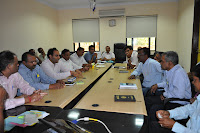
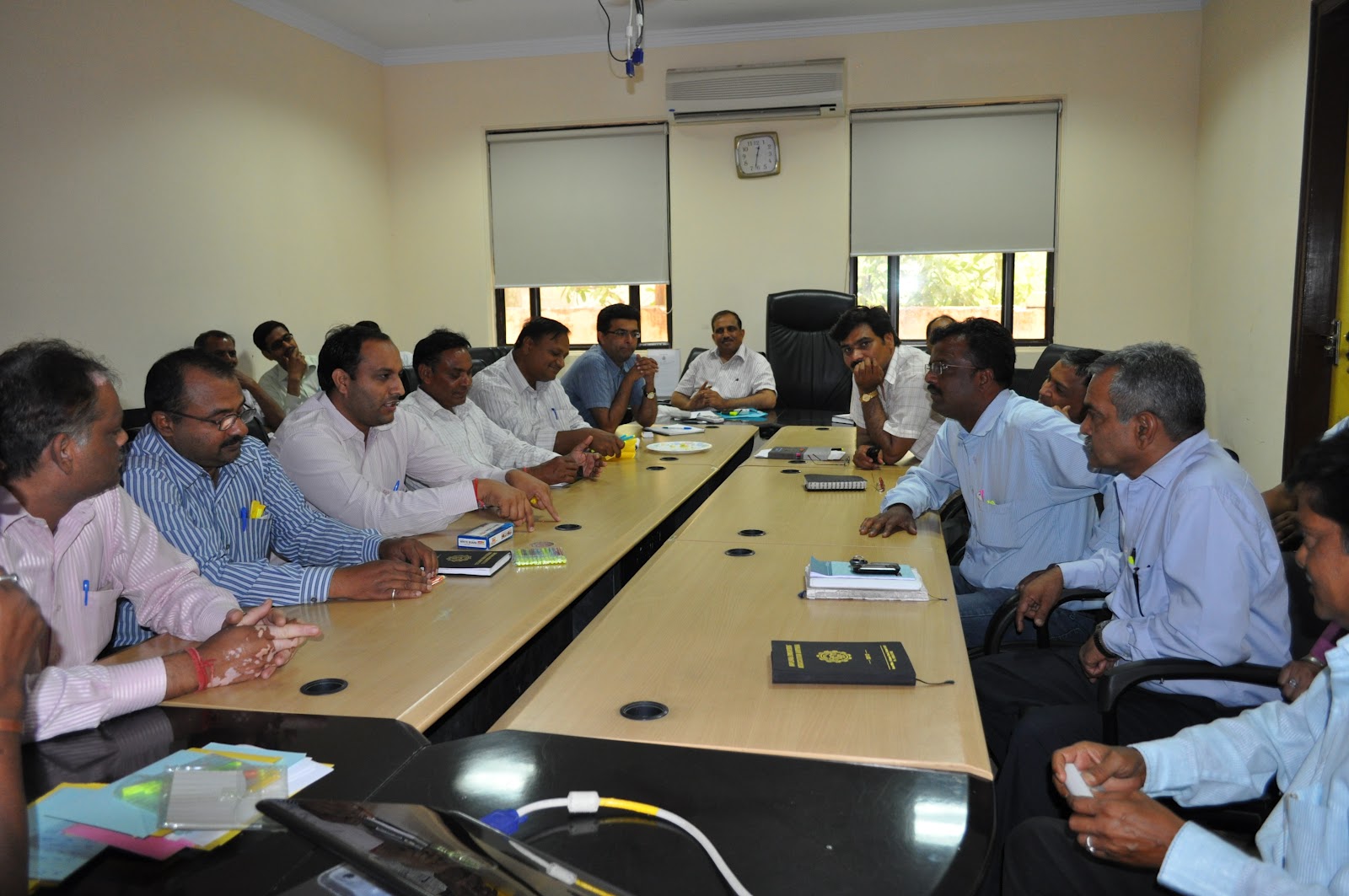
The second stakeholders’ workshop in Gurgaon under the IDRC Supported project ‘Water security in periurban South Asia: adapting to climate change and urbanization’ was organised on the 24th of June, 2012 at the Ramada, BMK, Gurgaon. Dr. Vishal Narain began by highlighting the agenda of the meeting which was mainly to:
-         Assess how far the PHED had come in terms of performing the tasks agreed to at the last meeting to improve the water access of communities in the villages of Sultanpur and Jhanjhrola Kheda
-         Identify any other areas  that needed face to face dialogue between the water users and the PHED (Public Health Engineering Department)
-         Identify the further course of action during the last year of the project to improve water security in these two villages
-         Identify ways of continuing this process of dialogue between the PHED and the water users beyond the project period 


 Dr. Vishal Narain then highlighted some of the work that had been taken up by the PHED and the progress made since the last meeting as also some of the issues that had been raised by the PHED in relation to local water management practices.

The PHED made a few suggestions and urged the villagers to try and pursue those at their level. These included -
  • ·         Informing the PHED about the illegal connections in the village, so that FIR could  be lodged against those who pursued such practises.
  • ·         Forming a Water Committee to monitor the work and maintenance of the system

Some more suggestions that came from the PHED included compulsory registration of personal tubewells with the Central Groundwater Board;  otherwise they would be seized very soon by the authorities. On enquiring about the tank set up by the PHED in Sultanpur on a portion of a private land, the PHED officials informed that it could not be shifted from the current location, but the owner could be compensated. Also regarding the alternate day availability of water for some of the households in the Sultanpur village, the PHED mentioned that as per their records, they were supplying 70 litres per day per person, but due to illegal connections, most of the water was being taken away by other households leaving some without any water.

The meeting concluded with some concerns that were raised by women panch members from Sultanpur, who felt that water quality testing was very important. Apart from this, there was a need to provide an alternative source of fresh water especially considering the poor families who did not have any means of filtration. Also a pipe connection for households across the railway line was of urgent need.


Summary and Conclusions

This meeting saw a lot of change in the attitude of both the villagers as well as the PHED. Since the purpose of the meeting was to foster dialogue between the water users and providers, and to find ways to jointly improve or solve the problems, both sides conducted themselves very well. As against the usual blame game and anarchy characterising the relationship between the water users and providers, this had taken the form of a disciplined, structured and focused interaction to chalk out a future course of action.

Saturday, June 30, 2012

Second Stakeholders’ meeting in Gurgaon – Participation of women representatives from the intervention villages


Recently, on 22nd June, Gurgaon team organized the second stakeholders’ meeting. The meeting was attended by 8 members from Sultanpur village, including two women representatives, and 4 members from Jhanjhrola Khera. PHED was represented by 1 Sub-divisional Engineer (SDE), 2 Junior Engineers and 2 staff from admin. One of the highlights of the meeting was participation by women representatives from villages. In order to mobilise women representatives from Jhanjhrola Khera and Sultanpur, team members from Gurgaon visited both the villages. In Sultanpur, team members could interact with couple of women Panchs from the village. They were told about the rationale behind organizing the stakeholders’ meeting. They agreed to come to the meeting and also assured that another woman Panch would also come on the day of the meeting. The team members then moved to Jhanjhrola Khera in order to interact with women representatives from the village. In Jhanjhrola Khera, team members spoke to couple of women Panchs and were ensure their participation on the day of the workshop. There were indications that another woman Panch from Jhanjhrola Khera would also come.

On the day of the workshop, a vehicle had been arranged to get women from the village and then drop them back after the meeting. Surprisingly, none of the women Panchs from Jhanjhrola Khera agreed to come for the meeting. One of them said that she had to go to a doctor, whereas the other one simply did not want to travel such a long distance and come to Gurgaon! Eventually, on the day of the meeting, two women Panchs from Sultanpur village came for the meeting. One of the women, amongst the two, belonged to a low caste, but she was able to put forward her points during the meeting. She raised the issue that in Sultanpur village, there was no water connections or pipes beyond the railway line, which was making it difficult for women in this section of village to access water. By the end of the meeting, PHED officials had agreed to survey this particular area and if satisfied with the water quality would arrange for setting a tubewell. The team considers this as an achievement, as women representatives generally do not have any say, even during Panchayat meetings, when they are represented by their male counterparts. However, during the second stakeholders’ meeting they were provided a platform to voice their opinion and by the end of the meeting, the team felt that they could actively do so. 

Thursday, May 31, 2012

Accessing drinking water in Jhanjhrola Khera – A private water tanker perspective


Visit to Farrukhnagar, a small town close to the two intervention villages in Gurgaon, indicates presence of a booming market, not just of the daily commodities, but also of water. The groundwater in this region is sweet, unlike the groundwater in Jhanjhrola Khera and main residential area in Sultanpur; the two intervention villages. Whereas in Sultanpur, villagers are able to access sweet drinking water from the area across the railway line, villagers in Jhanjhrola Khera are dependent on either the PHED (Public Health Engineering Department) supplied water or private water tankers for their drinking water demand. A few villagers in Jhanjhrola Khera also fetch water from a handpump in the village temple. Many villagers believe that the water in this handpump is also turning saline. Despite this, villagers continue to drink this, either because they have got used to this water or simply because there is no alternative arrangement. Thus, for some people it is not choice but compulsion that drives them to drink water from the village handpump. For many households, this water source is about 500 metres away, but in absence of any other option, they end up walking such a long distance to fetch water. In many households, the PHED supplied water is also criticized. As per them, water is supplied to them without any filtration. Many believe that this water is responsible for several diseases including skin disorders.

In such a scenario, a preferred bet for many households is to buy drinking water from private tankers. A total of about 5-6 people from Jhanjhrola Khera are into water tanker business.  All of them operate from Farrukhnagar. Out of the 5-6 water providers, 2 operate in the village and sell drinking water to the villagers. Sometimes, they also operate water tankers on behalf of the PHED, in order to supply water to villages where there is a fault with PHED water distribution system. Many water suppliers, supply water for the infrastructure companies, where sweet water is required for construction work. Approximate monthly earning of an individual in water business is about 35 to 40 thousand Rupees.

At village level, supply of the water from tankers leads to quarrels and conflicts, especially if the water supplied by PHED does not come due to any technical fault. Many villagers, who have the ability to pay for buying water from tankers, wish that there were more water suppliers in the village. They believe that since the water tanker supplies groundwater, unlike the water supplied by PHED which is surface water, it is best suited for drinking. They strongly believe that since the groundwater is filtered by natural process, it is more suited for drinking compared to surface water. Interestingly, there are a few villagers who find the PHED supplied water to be better suited for drinking compared to the water supplied by tankers! 

Tuesday, April 24, 2012

Vocational Training of youth from Sultanpur village in Peri-Urban Gurgaon


SaciWATERs collaborated with GMR Varalakshmi Centre of Empowerment and Livelihood for providing Capacity Building training for selected youth from Sultanpur village in Peri-urban Gurgaon. The duration of this collaboration was three months, starting from January 16th till April 16th, 2012. Objective of this collaboration was to provide a platform for village youths to learn newer skills, which in turn would provide an alternate source of livelihood for families solely dependent on agriculture. This is also part of the Gurgaon team’s effort to empower youth, in order to deal with likely loss of their source of livelihoods, once lands are either acquired or sold.

At the time of writing this blog, all five students had successfully completed their training. Four students enrolled in Refrigeration and Air-Conditioning (RAC) course have been offered on-the-job training (OJT) for 45 days. On completion of the OJT period, followed by another round of evaluation, they will become eligible for jobs in Voltas Company, one of the world’s premier engineering solutions providers and project specialists.

As a follow-up to the training, four students from the village were spoken to, in order to know their experiences and learning from the training programme. This blog post documents their views about the training, in their own words.

Name of Student – Mr. Madan Singh

Training Experience
The courses as well as teachers were good. RAC was the main course taught to us, however, we were given additional classes in Personality Development, English and Computer. All the courses were very good. Classes used to begin at 9:30 AM and end at 4:45 PM. Four classes were held daily. I did not have any prior knowledge of RAC, however, after four to five classes, I started finding it very interesting. A lot of emphasis was given to practical learning and we were also taken for plant/company visits near the Delhi airport. I believe that this training has provided me an alternate working option. I look forward to go for the OJT and also take up the opportunity to work. 

Name of Student – Mr. Rahul Chauhan

Training Experience
As the training progressed, my interest in RAC course increased. After completion of the course, I believe I have an additional ability/skill and I can think of pursuing this further as a livelihood option. Now, I can say that I can do something in addition to farming. It was a very good experience and teachers were also good. There was a sense on motivation from teacher’s side to make us learn the RAC course. I cannot think of any negative point associated with the training. The total batch size was about 16-17 students. About 10-11 students were from Delhi, 4 students from Sultanpur village and 2 students from Manesar. We could also interact with students from other courses and in the process, made many friends. Given an opportunity, I would definitely want to work.

Name of Student – Mr. Happy Sharma

Training Experience
The overall training experience was very good. It was my 1st such exposure to a training programme. In addition to academic knowledge, the training provided a platform for interaction with new people and make new friends. Another additional advantage was by exposure to courses such as Personality Development, Computer and English. There were no negatives associated with the training. I will definitely go for the OJT.

Name of Student – Mr. Pawan Kumar

Training Experience
Prior to joining the training programme, I did not know anything about personality development, but now, I know many things about it. After the three months training in electrical course, I can make all electrical fittings of my house. I can also open my own electronic shop and ensure that it runs successfully. Thus, now I can stand on my own legs. The environment at the training centre was very good. We also used to get different food daily. There was not even a single reason for any complaint. I have made many friends; some of them even belong to Jhansi. What I learnt over three months at the training centre is equal to whatever I was taught till my 10th standard school education! The English teacher was very good and I used to tell her that if I had earlier taken lessons from her, I would have been in a very good position by now. Teachers used to teach from the ground level. It is after 8 years of gap that I got into a formal training/education set-up. This could be one reason why I could not perform well in the course. Also, I have spoken about this course to other village youths and in future, they could be interested in going for such training programmes. 

Sunday, April 22, 2012

Capacity building workshop of Junior Engineers from Public Health Engineering Department, Gurgaon


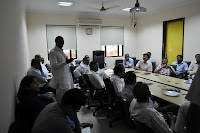
The capacity-building and training workshop of the employees of the PHED (Public Health and Engineering Department) was organized on the 12th of April, 2012. It was attended by nineteen employees of the rank of Junior Engineer (JE), two employees of the rank of Sub-divisional Engineer (SDE) and two employees of the rank of Executive Engineer (EE). They represented the divisions of Gurgaon, Faridabad and Sohna.

         
          Participants from Gurgaon, Faridabad and
 Sohna divisions of PHED 
Dr. Anjal Prakash briefing the participants
 about peri-urban water security project 

The workshop began with an introduction by Dr. Anjal Prakash on SaciWATERs and its activities as well as the on-going IDRC supported project on Water Security in Peri-urban South Asia – Adapting to Climate Change and Urbanization. He then lead the participants through a game in which they were given cards to introduce themselves in pairs as an ice-breaking exercise and to share their expectations from the workshop as well as one major challenge each  that they faced in their jobs and with regard to dealing with water as a resource. 
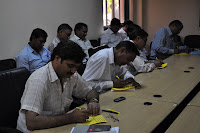
    
PHED Officials penning down their
expectations from the training
Participants sharing with their colleagues, 
expectations from the training, organizational challenges 
& challenges of dealing with water as a resource
The participants  identified several challenges that they were faced with: prominent among these were the low awareness among water users about how precious water resources were, rampant misuse of water, widespread illegal connections, abuse by water users including threats and occasional physical violence, poor distribution infrastructure and frequent burning of motors. They expressed concern over any lack of fear of public authority among water users because of which they misused water and abused PHED property.  While electricity thefts were considered as punishable in society,  the same did not seem to apply to water, that was considered a much more basic good and water thefts as legitimate ways of quenching thirst and meeting basic needs.  Another issue was the relationship between energy and water; on account of erratic power supply, water users pump water whenever electricity is available. Understaffing and the absence of mutual accountability relations between the water users and providers was another problem.

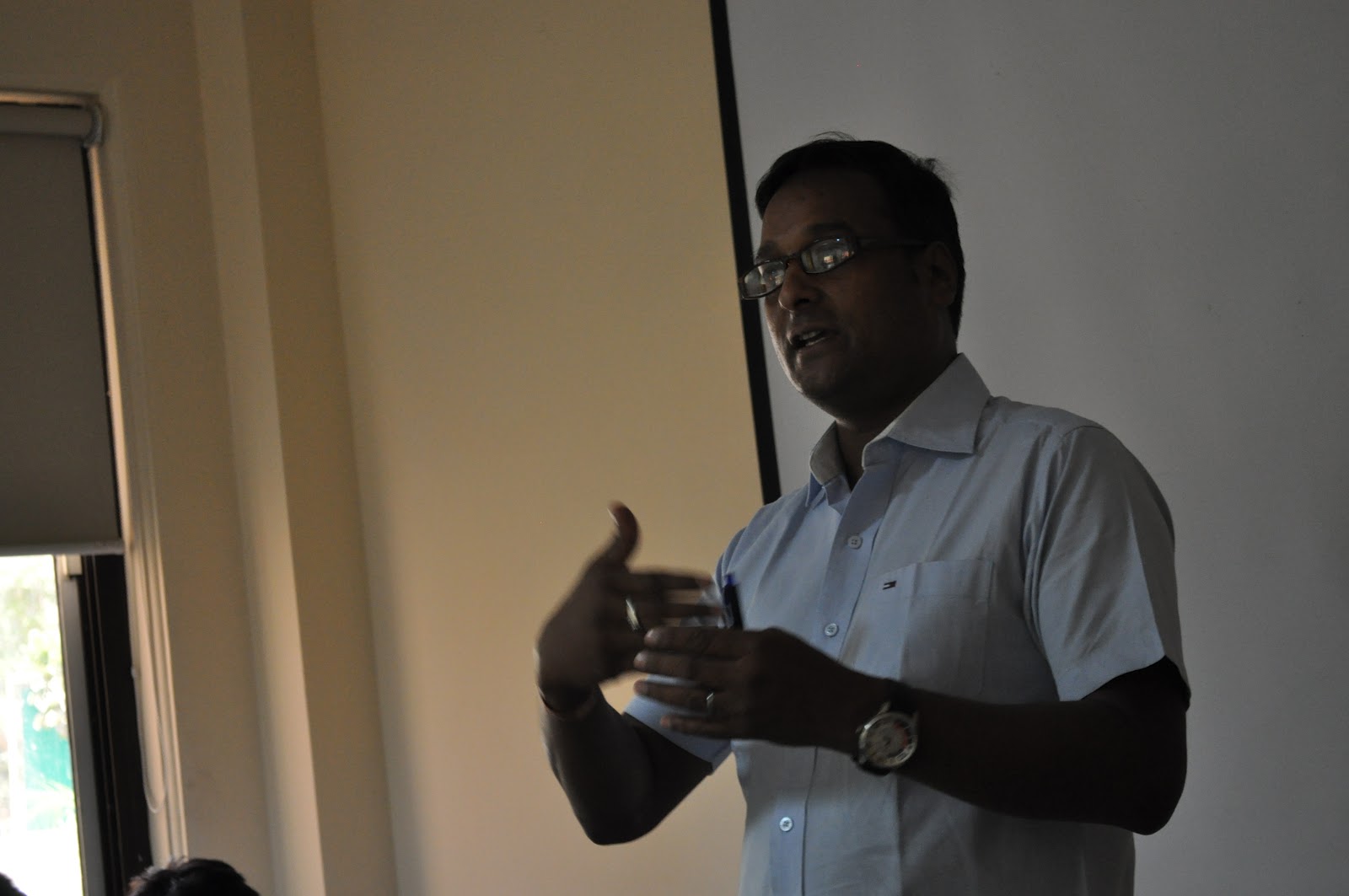
This was followed by a presentation by Dr. Vishal Narain who spoke about the need for the training of the employees of the PHED in the larger context of the current project. He said that urbanization and climate change were both impacting the water availability in peri-urban locations. These were aggravating the impacts of water insecurity already experienced by people on account of such factors as caste, class, gender and location. While the project was only of three-year duration, a long term engagement of the workshop participants with their field settings made a case for a sensitization to issues of peri-urban water security. The aim of the workshop was to supplement and enhance their skills in dealing with managerial and social issues.
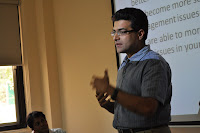
 
Dr. Vishal Narain briefing PHED officials
about rationale of the training 
As part of the role play, a dialogue in
progress between the villagers and PHED officials 

This was followed by an interesting role play led by Dr. Anjal Prakash in which the participants split into two groups; one each representing the villagers and the PHED. Two senior participants were designated as observers. The team representing the village then approached the team representing the PHED. The villagers complained to the PHED regarding the absence of water supply for ten days; a blame game and accusations followed. After the role play, the observers presented their observations, namely, that the villagers while accusing the PHED of poor supply did not mention the specific problem or reasons. Nor did the PHED representatives try to find out or explore what the problem was. The overall message was that both sides should have communicated more effectively and clearly.

This was followed by a discussion on several problems in providing water supply to peri-urban locations.  An important issue raised was that rapid urbanization invited migrants who came in as temporary settlers in areas where they were not registered or shown as inhabitants. This leads to underestimation of population to be served and results in several errors in planning. Since water is considered basic to human sustenance, water thefts are not even recognized as such.  Field staffs often face the lure of money as a corrupting influence on one hand and threats and physical assault on the other.  Even if PHED property is damaged and an FIR is sought to be lodged, such a request is not entertained.

This was followed by a short presentation by Dr. Anjal Prakash on gender issues in water supply and he shared experience with a range of water supply improvement options and solutions in peri-urban, urban and informal contexts. He also gave examples of cases where water supply had improved even under conditions of water scarcity and suggested the possibility of organizing an exposure visit of PHED employees to see such successful experiments. 

In the afternoon, the group was joined by representatives from Sultanpur village. The afternoon session began with the screening of a participatory video that was scripted, acted out and shot by a group of women from Jhanjhrola Khera. The video was about the health effects of consuming unsafe water and how women could take precautions through a wide range of options for treating water before drinking. 


Screening of Participatory Video
 from Jhanjhrola Khera

The village headman from
Sultanpur interacting with PHED officials 

This was followed by a dialogue between the representatives of Sultanpur and the workshop participants. The former shared their experiences and problems in getting drinking water in the village. They get water from the Gurgaon Water Supply Channel. There is a problem of water distribution internally. They have cement pipes that are easy to rupture or break or take illegal connections. These pipes need to be replaced by D.I. (Ductile Iron) pipes. The workshop participants from the PHED said that it was important to have tutis (taps) installed over all the connections to prevent wastage of water. Mr. Pradeep Kumar, the Executive Engineer in-charge of Sultanpur then suggested that as a follow-up to the local stakeholders meeting that was organized in the village, he had placed order for replacement of the pipe by a D.I. pipe, that had been approved. In due course, this would be done and then through a village level meeting, they could develop a plan for forming a water management committee and handing over the distribution infrastructure to them.

The meeting ended with a round of circulation of cards on which the participants scribbled their major learning. For most participants, the major takeaway was the need for more effective communication between water users and service providers. As a follow-up, Dr. Anjal Prakash suggested a continued engagement with the PHED and the possibility of further capacity-building activities through exposure visits as well as training on technical issues and subjects. 

Saturday, March 31, 2012

Demystifying Village ‘Dhaanis’ in Peri-urban Gurgaon – Insights from Jhanjhrola Khera


Jhanjhrola Khera, one of the intervention villages in Gurgaon, has about 50 households located in the village fields/agricultural land, away from the main settlement area of the village. These settlements are called ‘Dhaani’ as per the local dialect. As a researcher, one always wonders what led to such settlement pattern, when it happened, what status do they have in terms of voting rights, how is the settlement named, where is it located etc.

In Jhanjhrola Khera, settlement of people in Dhaani has taken place over last 10-15 to 50 years. Also, not all 50 households are located at same place. They are divided across 15 small groups, each comprising of 3-4 households. In terms of caste composition, Yadavs are in preponderance, with close to 46-47 houses. Pandit, Jaat and Rajput community have a single household each. In terms of access to main roads, people can either go to the adjacent village viz. Mubarakpur, or take the highway and reach Sultanpur village or walk down through the settlement area of Jhanjhrola Khera. In terms of voting right, these households belong to a specific ward number from the village and are allowed to cast votes. Their access to water is through the same water supply pipeline that supplies to Jhanjhrola Khera, Sultanpur, Iqbalpur and Mubarakpur. In order to understand the flow of water with respect to Jhanjhrola Khera Dhaani, one needs to know that water first reaches Jhanjhrola Khera. The main pipeline that supplies to Jhanjhrola Khera goes further ahead and supplies to Mubarakpur. Jhanjhrola Khera Dhaani is in between these two villages. So, households have taken connections from this pipeline in order to meet their daily water demand. One may wonder, if the village Dhaanis exercise same level of rights, as the main village, in case the water supply system fails!

Settlement of people in these Dhaanis has been driven by numerous factors. For instance, farmers who had smaller plots in the village settlement area, decided to settle down in their own agricultural land, which were big and thus allowed more individuals to live together in a family. Thus, increase in family size could also be a factor that has led to settlement of people in Dhaani. Farmers whose agriculture fields were far away from the village, also moved to the village Dhaani. This way, they could save the time needed to reach their fields. It also saved time needed by women to carry lunch to their family members working in fields. Carrying fodder also became easier. As per a farmer from the village, people who did not mingle much with other villagers, also decided to settle down in Dhaani. Apart from these factors, movement of people to Dhaanis have also been driven by easier access to sweet water. A common remark from people, when asked about how they used to access drinking water in past is, “pehle to hum kheton se paani bhar laaya karte the”, i.e. we used to fetch water from the fields. In Sultanpur, a nearby village, settlement of people outside the official village settlement area, has been solely driven by availability of sweet water! Thus, availability and access to water is another important factor that is responsible for movement of people to village Dhaani.  

Being an integral part of any village, Dhaanis do have interesting dynamics associated with them, especially in terms of their access to resources. Thus, it is important to take them into consideration and understand these dynamics, as part of research work.  

Wednesday, February 29, 2012

A day in Public Health Department’s office in Gurgaon


Last year, a visit to the local health department turned out to be an eventful one. I had gone to meet a senior official, in order to seek his permission for a possible interview. To my surprise, a group of about 30 men and women from a village in Gurgaon district, entered the office and started complaining about the water issues in their village. It was quite a sight, as the office atmosphere suddenly turned into that of commotion, with everyone talking and arguing. The village women, about 15 in number, were also not holding themselves back. One could understand that the villagers were not satisfied with the water situation in their village. Also, they were complaining about the location of water boosting point that was to be constructed in their village. As per them, the proposed location of the boosting point was faulty and could never deal with the village water woes.

I had read about such situations in newspapers but was never witness to them. Being witness to such an event for the first time, I could not envisage any improvement in the situation. However, it was all happening right in front of my eyes! After about 5 minutes of pandemonium, the PHED official asked one person among the villagers to put forward their point. After listening to them, the official assured the villagers that he will personally visit the village and ensure that the issue about location of boosting point is taken care of. He also used urged villagers not to waste water as it is a limited resource. He went on to add that there was no scarcity of water, but the issue is mainly that of water management. Villagers agreed to this and assured that they will provide full support to the government department. The official then exchanged his phone number with one of the villager in order to ensure that they do not have to make such a visit to the PHED office. He assured that he will remain in contact with him and ensure that the water situation in the village improves. As the group of people were leaving, womenfolk turned back and appealed the official to help them get rid of the water issues. It was quite heartening to listen one of them say, “Take away our land, but provide us water”! Another woman added, “Government promises us ghee, but does not even provide water”!

Thus, what started as a situation that could go out of control was eventually sorted out amicably. In fact, the issue with faulty location of water boosting point is common for one of our intervention villages. However, proper placement of water distribution pipelines has given hope to the villagers that water will reach everywhere.

So, a day that had started as any other regular filed visit day, turned out to be very interesting and also dramatic! One gets to experience such events, only in the field!! 

Friday, January 27, 2012

Participatory Video Activity in Jhanjhrola Khera, Gurgaon – Basic premise, outputs and challenges


Participatory Video (PV) activity was undertaken in Jhanjhrola Khera, one of the intervention villages in Gurgaon, in December 2011 over a span of four days. It was conducted by Dr. Rana Ghose from IDRC, with the help of Ms. Tarini Manchanda and Mr. Pranay Ranjan. The activity acted as a medium of engaging with the village community and also empowering them to make bureaucracy more responsive. The basic premise was to first teach villagers about using video camera and then let them film their own story, in context of water. Over the first two days, about 20 villagers, including women, were taught about video camera usage, angles, different types of shots, ways of scripting story etc. On the last day, couple of village youths were also taught about editing a video. Eventually, two videos were made, one by village women on water cleanliness and the other one by village elderly and youth, in which they talked about village water issues. The combined run time of videos was about 40 minutes and it was shown to the village community on the last day of the PV activity. After the screening, villagers were also asked for their comments. A village elderly appreciated our efforts and urged the PHED (Public Health and Engineering Department) to actively work on village water issues. A woman from the village considered the activity to be a source of additional knowledge for her and other women involved with the video shoot. She urged villagers to consider the video as a source of learning and also practise means by which water could be kept clean!
A group of women watching the video on water cleanliness

This blog post would like to bring up some of the challenges faced by the team while carrying out PV activity. Since the activity was spread over four days, the first and foremost challenge was to ensure that same set of people joined the team every day, at least for about 4 to 5 hours. This was a big challenge as many times during the activity, it happened that the team would end up with a new set of people because some of them had to leave. The other challenge was to get women to learn about using a camera. In fact, on the first day of the activity, it so happened that couple of women were told about camera usage. However, when they were actually asked to hold the camera and film something, they were suddenly very reluctant and decided to walk off! Despite our repeated requests they did not want to continue with the activity! This came as quite a surprise to the team, as they had earlier sounded very keen on learning about video camera usage. The other challenge was to decide on number of people team would want to limit itself to, considering the constraints such as manpower, number of cameras etc. in mind. In fact, as per initial plans the activity was to be carried out with a group of 6 people, however, it eventually turned out to be an activity involving 20 people! Another challenge was to make people understand the value of filming their own experiences. Many a times they would question why should they learn to film their own story? The team screened couple of videos to the participating group, of instances when villagers have filmed their own stories and used it as a tool to voice their opinion. The video made by Dr. Ghose for world water week in Stockholm, was also screened in order to make them understand the difference when someone else makes a video and when it is made by people themselves.


Village residents who had gathered for the video screening
Despite all the challenges, at the end of the activity, the team was quite satisfied with the response and output. A very positive outcome was active participation of women, who also showed interest in participating in activities that would be carried out in future. By way of filming their experiences with water, the villagers also learnt about using this as a tool to make service providers more responsive.

Thursday, December 8, 2011

Water – Then and Now (A Personal Note)


A very recent visit to my ancestral village in Bihar was much different from the numerous visits I have made in the past. As a child, I was never aware of the village water issues. Though, I was aware that water in the well dug inside our house was not fit for drinking. I also knew that a major section of the village fetched drinking water from a common well, popularly known as ‘Gopi saa ka kuaan’ – Gopi saa must have been name of a village elderly and ‘Kuaan’ is a Hindi word for well. Many days have passed, but I can still recall the taste of sweet water from this well. Going back to the household scenario, being a joint family, fetching water was indeed a day long ritual for my uncle and cousins residing in the village. Being a visitor and also because I was the youngest among my cousins, I was never asked to fetch water! Now when I see villagers residing in peri-urban villages of Gurgaon, fetching drinking water, I can easily connect with it, emotionally. A subtle difference is the backdrop. On one hand, where my ancestral village has predominantly ‘Kaccha’ houses, these peri-urban villages on the other hand, have newly made concrete houses. However, access to drinking water continues to be a problem. Out of the four villages selected for research, fetching drinking water is a daily activity in three villages. In Sultanpur, villagers walk down to common hand pumps beyond the railway line. In Jhanjhrola Khera, in addition to fetching water from common hand pumps, a vibrant tanker water economy also flourishes. In Budheda, people walk down to hand pumps adjacent to the Gurgaon Water Supply channel to fetch water.

The trip to my ancestral village provided many more insights. I realised that the village has a drinking water supply provided by the public health department. On enquiring about the water supply, I realised that the water supply was erratic and also unequally distributed. In fact, my uncle went on to say that government had wasted money in providing water, as the situation has not improved. He rues paying about Rs. 400 for getting a connection of the supplied water. This issue is prevalent in couple of research sites in Gurgaon as well. Another interesting insight was about the use of village waste water. During this trip, I realised that ponds that I had been seeing since my childhood days, were actually storage points for village waste water. Not just that, this water has been used by villager for growing numerous crops from past 20-25 years. Another uncle of mine, who also happens to be one of the prominent businessmen in the village, was surprised when I told him that consumption of crops grown using this water, could have negative health impacts! In Gurgaon, we come across this aspect in Budheda and Sadhraana.

In short, what I realised during this short visit to my village, was that I had been living in oblivion so far. I also realised that conducting research on water issues has made me more open and aware of my surroundings. It is only because of my current professional and academic tuning that I have become capable of not just identifying these issues but also to look for pragmatic solutions!

Wednesday, November 9, 2011

PRA activities in Sultanpur and Jhanjhrola Khera by TERI University students


Introduction

On 20th and 21st October, seventeen Master’s student from TERI University visited the research sites in Gurgaon. They are enrolled in the M.A. Sustainable Development Practice programme. The objective of the visit was to help them understand how PRAs are used to understand rural life. On 20th October the students visited Sultanpur village, followed by a visit to Jhanjhrola Khera on the next day. It was a diverse group of students, coming not just from different states in India, but also from different countries. A brief note of activities undertaken by students in both the villages is mentioned below.

Sultanpur

The students arrived in Sultanpur at about 10 AM. A walk to the village Sarpanch’s meeting room, called ‘Baithak’ in local parlance, was sufficient to draw villager’s attention towards students. Once everyone was seated in the ‘Baithak’, Dr. Vishal Narain briefed the village head and other villagers about why the students had come to the village. This was followed by a quick round of introduction by TERI students as well as the villagers. After this, the group moved to ‘Dharamshala’ to carry out the PRA activities. All the activities were done with active participation of the village people. One of the first activities was making of the village map. 


This turned out to be very interesting for villagers, as they were introduced to such activities for the first time. Many a times, suggestions made by one villager would get contradicted by a fellow villager, especially while delineating specific locations of certain places in the village! But eventually a consensus would be reached and the activity would go on. The combined effort of villagers and students paid off, as the colourful markings on the map made the village look beautiful even on a piece of paper! After this, students formed two to three groups and sat down with group of villagers to carry out other PRA activities like Trend lines, Wealth ranking, Seasonality analysis etc. A map outlining the distribution of supplied water pipelines was also made. This was followed by a transect walk across the village. An integral part of PRAs is sharing the knowledge back with the village communities. This was done in the second half of the day, wherein, the village head and other Panchayat and village members were invited. 


All the drawn maps were shown to them and asked for their views and comments. This was the time when some corrections were done to maps based on a mutual consensus among participants. The visit concluded with a final vote of thanks by the students.

Jhanjhrola Khera (JK)

The students arrived in JK at about 9:45 AM. Like Sultanpur, to begin with, a small meeting with villagers and the Sarpanch was held in his house. A quick round of briefing about the activity was followed by a session of mutual introduction. This was followed by some light snacks and tea. After this, a decision was to be made about the location where the activities would be carried out. Dr. Narain aptly suggested it to be the village temple premise. This turned out to be one of the highlights of the PRA activity in JK. Apart from the scenic beauty, the temple premise provided students with a larger space for innovation (as the village map was made on ground) and also for participation by the villagers, as it was a location frequently accessed by them.


Lots of innovation and imagination was employed in making the village map. For example, pebbles were used to highlight sections in the village that are at higher elevation and thus face difficulty in accessing water. Like Sultanpur, this was followed by doing other PRA activities. Students also walked across sections of village. In JK, students were also able to speak to women folk. This was done separately, with a group of 4 to 5 students speaking to a woman in her house. The questions put forth to them were not limited to water, but also about their daily activities, education level of children (especially female children), etc. The women folk targeted were a mix of women from high as well as low castes. 


The post lunch session was about sharing with villagers what was learnt from them. This session saw participation of many villagers, including women and kids. It was nice to see some school kids also making their own point about village and other maps. Although women could not be part of the PRA activity in the beginning, women who came to the temple for fetching water, got curious about the ongoing activity and decided to join. They did not hold themselves from putting forth their points!


This was a session where corrections, as and when required, were done. Also, any other important points mentioned by villagers were noted down. The day concluded with heartfelt thanks to the villagers for their participation. Overall, the second and final day of the PRA activity, turned out to be more vibrant, participatory and colourful! 

Sunday, September 25, 2011

Village level dynamics over formation of water committee – Field experience


As a follow-up to the decisions taken during CB and stakeholders’ workshop in Gurgaon, efforts are being made towards formation of a village level water committee. However, village dynamics come into picture when one goes about forming the committee.  Below is an account of our interaction with the Sarpanch in Sultanpur village. The field visit was made by Pranay Ranjan and Dr. Vishal Narain.

One of the highlights of the day was the conversation we could have with the village Sarpanch. He was slightly busy with his responsibility of distributing old age pension to the fellow villagers. Sarpanch of a nearby village, Kaliawas, was also around. Interestingly, when the Sultanpur Sarpanch mentioned that water pipelines in his village are in a dilapidated stage, the Kaliawas Sarpanch agreed with him and said that his village also faces the same issue. Susheel ji, the Sultanpur Sarpanch, went on to add that it is only when the old cement pipes are changed and new Iron pipes are re-laid that the water situation will improve. We also asked him what he wanted to do next in order to improve the water situation in this village. His first reaction to this question was ‘aap batao, aapka kya programme hai’, which means, ‘you tell me what is your programme’! We had to reiterate the fact that it is a village issue and the villagers need to take the initiative and come forward on this. In the same context, we asked him for his views on formation of village level water management committee. To this, he said that it will be possible to form the committee only after the water pipes have been changed and water starts reaching every house. It is only then that one needs to form a committee that looks after the water issues. He added that even if a committee is formed, he and other Panchayat members would have to do all the running around. People will not take much initiative. ‘Committee ban bhi gayee, to kaam to mujhe hi karna padega’. (‘Even if the committee is formed I will have to do all the work’,) he said.

We also took this opportunity to ask him if he thinks that some improvement has happened in responsiveness of service providers since the inception of our work in the village. To this, he said that there has been a lot of improvement in this regard. We also told him about the importance of putting pressure on service providers, in order for them to deliver. We also said that we are around whenever they need any help. However, they should take up the water issues actively on their part as well. To this, the Sarpanch said that, ‘Thoda aap dabaaw daalte raho, thoda hum bhi dabaaw daalte rahein to kaam sahi ho jayega! What this means is, ‘you put some pressure, we will also put some pressure; by doing so, the work will get done’! 

Sunday, July 17, 2011

An account of experiences with government departments/officials in Gurgaon

An integral part of the project work has been constant visits to different government offices such as office of HUDA (Haryana Urban Development Authority), Irrigation Department, Agriculture Department, Public Health Engineering Department (PHED), office of local Block Development Officers etc. As a new visitor to these offices, one slowly gets to learn the precepts and work dynamics associated with them. Irrespective of all the offices visited so far, a common observation has been that of existence of ‘Hierarchy’. On one hand where the higher official will have an air-conditioned room to himself, a junior level officer, on the other hand, will have a common workplace. Another common phenomenon is the repeated number of visits made by junior officer to the office/room of senior official of his/her department. This seems like an everyday phenomenon! An important observation in these offices has been virtual non-existence of women, especially at the posts that require specialization in a particular field of engineering.

Howsoever banal these observations may sound; they do speak a lot about functioning of these offices in general and also about their work culture. The action/intervention part of the project requires closer association/interaction with these departments. The aforementioned observations simply add to and are part of interacting with them. Active participation of PHED officials in the Gurgaon Stakeholders’ and Capacity Building (CB) Workshop, are evidences of a fruitful association in the making. Recently, when the Gurgaon team approached a higher official from PHED for permission to film an interview with him, the permission was granted very easily. This again points out towards an increasing level of confidence and camaraderie that has been built up with the department. Experiences with other departments have also been good. When the irrigation department was approached with the issue of ‘flooded fields in Budheda’, the official agreed to share with us the data/maps on the reasons behind flooding of the fields. He also showed his willingness to do away with this issue before the next rainy season. Similarly, when a superintending engineer from HUDA was approached, he became very interested in the project conceptualization and approach. Although he could not attend the CB Workshop organized by the Gurgaon team due his busy schedule, he wanted a copy of the workshop proceedings to be handed over to him. This only shows willingness on the part of these government offices to share and contribute to the objectives of the project. Considering that this is an action research project, cooperation from government departments, harbingers well, not only for the project but also for the peri-urban communities.

Sunday, June 12, 2011

Understanding water security from gender perspective in Peri-urban Gurgaon


‘Roti, Kapda aur Makaan’ – Food, Cloth and House, this old saying certainly needs another addition in the form of Paani (water). So, the new saying would rather be ‘Roti, Kapda, Paani aur Makaan’ in this age of rapid urbanization! Field visits to peri-urban villages in Gurgaon have provided very interesting gender perspective of water issues. This particular blog post will focus mainly on women’s’ perspective.

During last year’s winter, on the very first day of formal field visit to Jhanjhrola Khera, interview with an old lady could not be completed as she became very vocal about water issues and simply walked away. Coincidentally, that was my first day of field work and I decided to observe this phenomenon very carefully during the course of next field visits. Over numerous visits, it was observed that in general, women spoke fervently and were more vocal than men, about water issues in the village. During one such visit to Jhanjhrola Khera, we came across a woman who had taken about 17 acres of land on Kann (A type of land tenure system). Her husband worked in a company in Gurgaon and she was left to take care of this vast stretch of land. She also had to fetch water for household consumption daily from the hand pump in village temple. Fetching drinking water from this hand pump is part of daily routine of many other women in the village. At times, they have to wait for about forty-fifty minutes for their turn to get water. The situation becomes worse in summer when they have to make numerous trips to the hand pump and also wait longer in queues. In Sultanpur village, the routes to such common hand pumps have been diverted with the construction of railway station. Women are forced to take a relatively longer route to be able to fetch water. A very interesting comment from womenfolk in Jhanjhrola Khera has been that the daughters in this village are better off, as they get married and leave the village. But women, who get married in this village, are at loss since they have to fetch water all the time!

Fetching water from such community hand pumps also signals towards change in traditions. During a visit to one ‘Rajput’ household, it was found that traditionally, in ‘Rajput’ families, women from the house never went to fetch water. However, the male member of the household admitted that this tradition does not hold true anymore. In his words, ‘ab parda paat gaya hai’ – the curtain has been removed! He went on to add that the household will not function if the tradition is followed even now.

Women are closely related to water usage, as they have to take care of the day to day needs. However, they have to struggle more for their access to water for daily requirements. The issue of women empowerment surfaces out in this context. Although the village Panchayats in Haryana have 50% seats reserved for women, they are hardly able to make any decisions about the village issues. The panchayat meetings are attended by respective male counterparts and the woman representative is simply required to give her signature to validate the decision. This is where need arises of their empowerment in real sense and not just on paper.