
The capacity-building
and training workshop of the employees of the PHED (Public Health and
Engineering Department) was organized on the 12th of April, 2012. It
was attended by nineteen employees of the rank of Junior Engineer (JE), two employees
of the rank of Sub-divisional Engineer (SDE) and two employees of the rank of Executive
Engineer (EE). They represented the divisions of Gurgaon, Faridabad and Sohna.
 |
Participants from Gurgaon, Faridabad and
Sohna
divisions of PHED
|
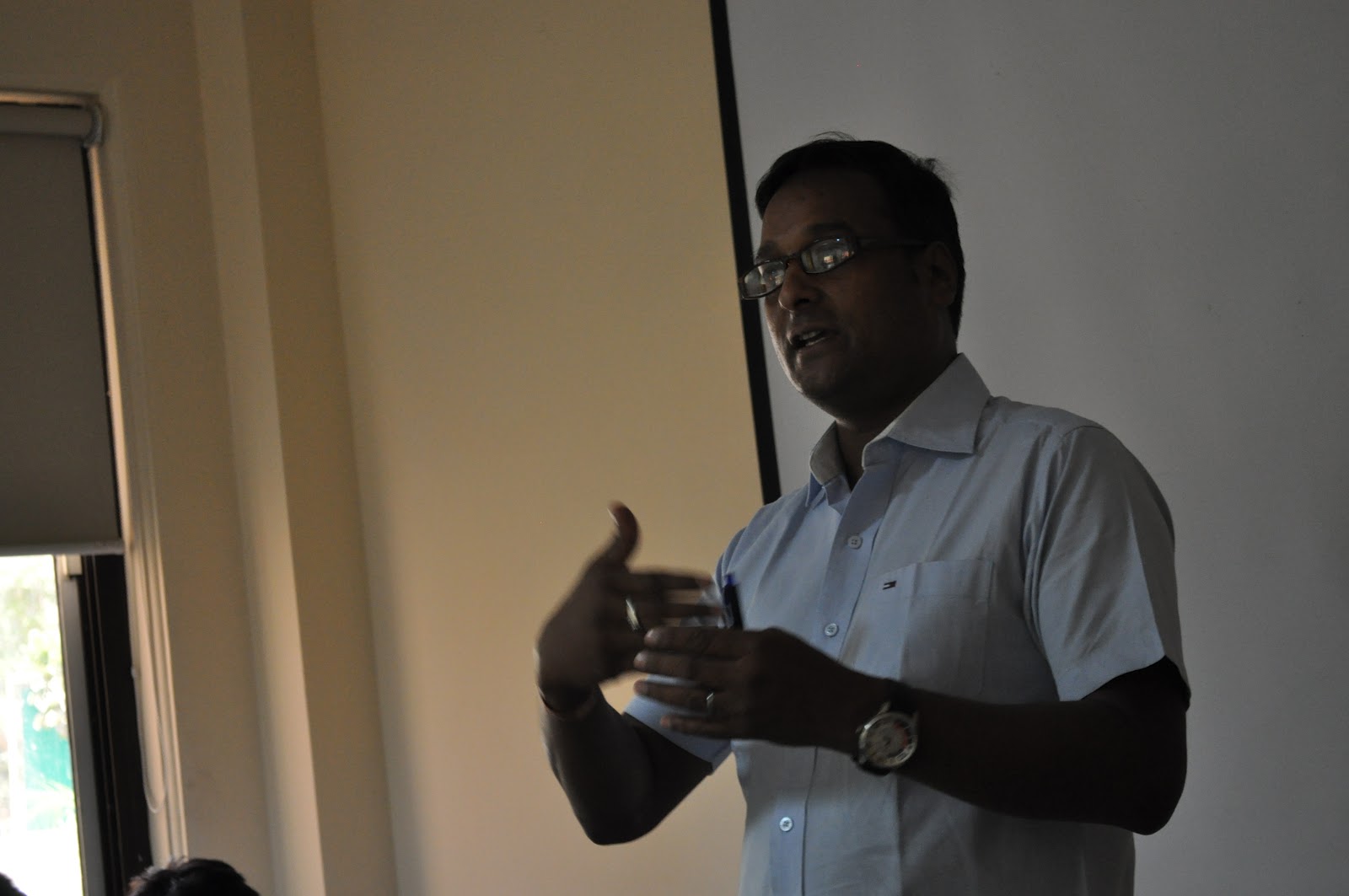 |
| Dr. Anjal Prakash
briefing the participants about peri-urban water security project |
The workshop began with
an introduction by Dr. Anjal Prakash on SaciWATERs and its activities as well
as the on-going IDRC supported project on Water Security in Peri-urban South
Asia – Adapting to Climate Change and Urbanization. He then lead the
participants through a game in which they were given cards to introduce
themselves in pairs as an ice-breaking exercise and to share their expectations
from the workshop as well as one major challenge each that they faced in their jobs and with regard
to dealing with water as a resource.
 |
| PHED Officials
penning down their expectations from the training |
 |
Participants sharing with their colleagues,
expectations from the training, organizational challenges
& challenges of
dealing with water as a resource
|
The participants identified several challenges that they were
faced with: prominent among these were the low awareness among water users
about how precious water resources were, rampant misuse of water, widespread
illegal connections, abuse by water users including threats and occasional
physical violence, poor distribution infrastructure and frequent burning of
motors. They expressed concern over any lack of fear of public authority among
water users because of which they misused water and abused PHED property. While electricity thefts were considered as
punishable in society, the same did not
seem to apply to water, that was considered a much more basic good and water
thefts as legitimate ways of quenching thirst and meeting basic needs. Another issue was the relationship between
energy and water; on account of erratic power supply, water users pump water
whenever electricity is available. Understaffing and the absence of mutual
accountability relations between the water users and providers was another
problem.
This was followed by a
presentation by Dr. Vishal Narain who spoke about the need for the training of
the employees of the PHED in the larger context of the current project. He said
that urbanization and climate change were both impacting the water availability
in peri-urban locations. These were aggravating the impacts of water insecurity
already experienced by people on account of such factors as caste, class,
gender and location. While the project was only of three-year duration, a long
term engagement of the workshop participants with their field settings made a
case for a sensitization to issues of peri-urban water security. The aim of the
workshop was to supplement and enhance their skills in dealing with managerial
and social issues.
 |
| Dr. Vishal Narain
briefing PHED officials about rationale of the training |
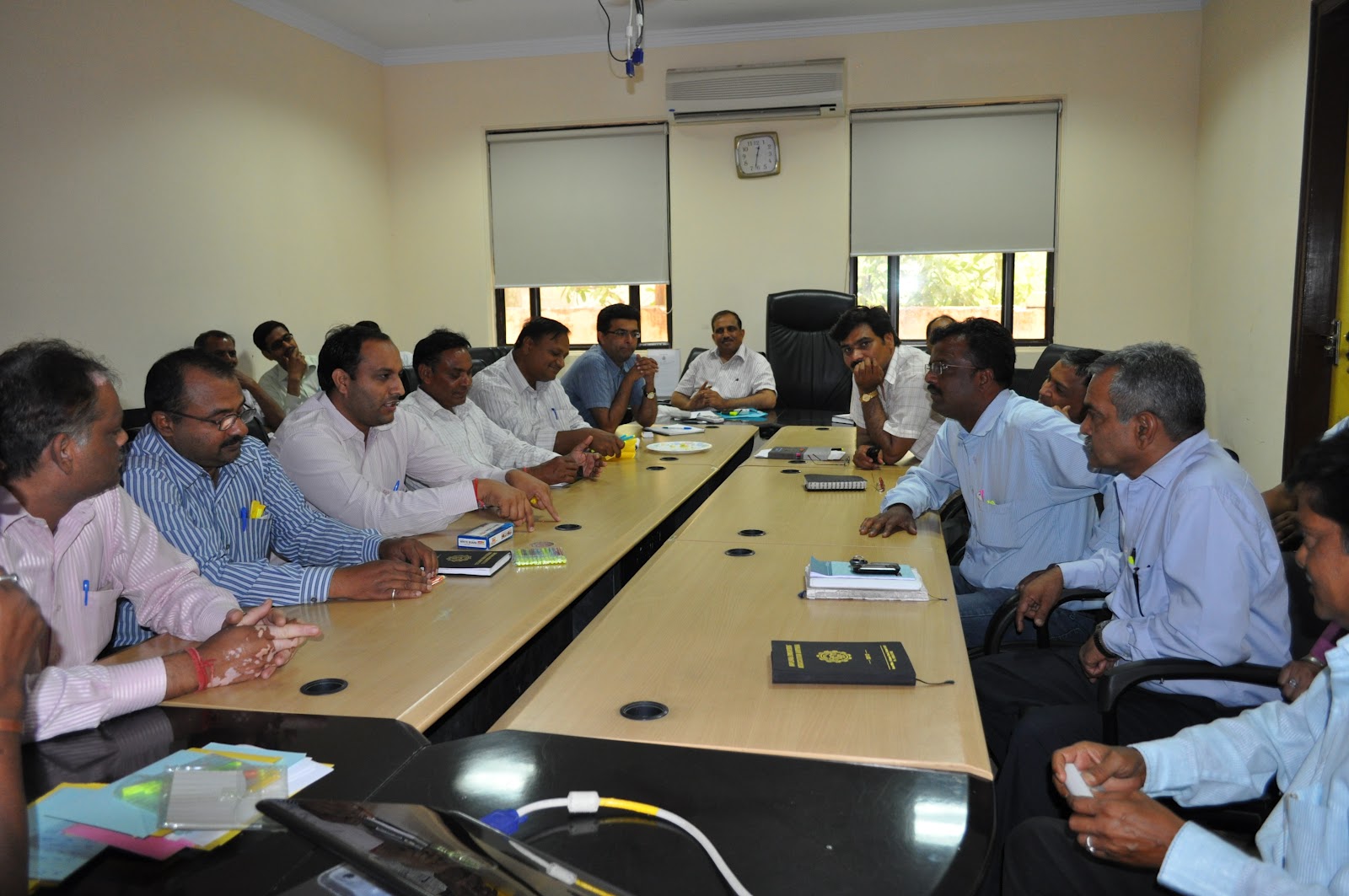 |
| As part of the role
play, a dialogue in progress between the villagers and PHED officials |
This was followed by an
interesting role play led by Dr. Anjal Prakash in which the participants split
into two groups; one each representing the villagers and the PHED. Two senior
participants were designated as observers. The team representing the village
then approached the team representing the PHED. The villagers complained to the
PHED regarding the absence of water supply for ten days; a blame game and
accusations followed. After the role play, the observers presented their
observations, namely, that the villagers while accusing the PHED of poor supply
did not mention the specific problem or reasons. Nor did the PHED
representatives try to find out or explore what the problem was. The overall
message was that both sides should have communicated more effectively and
clearly.
This was followed by a discussion
on several problems in providing water supply to peri-urban locations. An important issue raised was that rapid
urbanization invited migrants who came in as temporary settlers in areas where
they were not registered or shown as inhabitants. This leads to underestimation
of population to be served and results in several errors in planning. Since
water is considered basic to human sustenance, water thefts are not even recognized
as such. Field staffs often face the
lure of money as a corrupting influence on one hand and threats and physical
assault on the other. Even if PHED
property is damaged and an FIR is sought to be lodged, such a request is not
entertained.
This was followed by a
short presentation by Dr. Anjal Prakash on gender issues in water supply and he
shared experience with a range of water supply improvement options and
solutions in peri-urban, urban and informal contexts. He also gave examples of
cases where water supply had improved even under conditions of water scarcity
and suggested the possibility of organizing an exposure visit of PHED employees
to see such successful experiments.
In the afternoon, the
group was joined by representatives from Sultanpur village. The afternoon
session began with the screening of a participatory video that was scripted,
acted out and shot by a group of women from Jhanjhrola Khera. The video was
about the health effects of consuming unsafe water and how women could take
precautions through a wide range of options for treating water before drinking.
 |
| Screening of
Participatory Video from Jhanjhrola Khera |
 |
| The village headman
from Sultanpur interacting with PHED officials |
This was followed by a dialogue
between the representatives of Sultanpur and the workshop participants. The
former shared their experiences and problems in getting drinking water in the
village. They get water from the Gurgaon Water Supply Channel. There is a
problem of water distribution internally. They have cement pipes that are easy
to rupture or break or take illegal connections. These pipes need to be
replaced by D.I. (Ductile Iron) pipes. The workshop participants from the PHED said
that it was important to have tutis (taps)
installed over all the connections to prevent wastage of water. Mr. Pradeep Kumar,
the Executive Engineer in-charge of Sultanpur then suggested that as a
follow-up to the local stakeholders meeting that was organized in the village,
he had placed order for replacement of the pipe by a D.I. pipe, that had been
approved. In due course, this would be done and then through a village level
meeting, they could develop a plan for forming a water management committee and
handing over the distribution infrastructure to them.
The meeting ended with
a round of circulation of cards on which the participants scribbled their major
learning. For most participants, the major takeaway was the need for more
effective communication between water users and service providers. As a
follow-up, Dr. Anjal Prakash suggested a continued engagement with the PHED and
the possibility of further capacity-building activities through exposure visits
as well as training on technical issues and subjects.


